
More than 20 years after introducing its Stress Management Standards, Britain’s health and safety regulator appears unable to readily establish how often it has taken enforcement action against employers failing to manage work-related stress.
Work-related stress, depression and anxiety represent one of the most significant occupational health challenges facing workers in Scotland and across Great Britain. The consequences for workers, their families, public services and the wider economy are considerable.
Recent Health and Safety Executive (HSE) statistics examined by Scottish Hazards indicate that 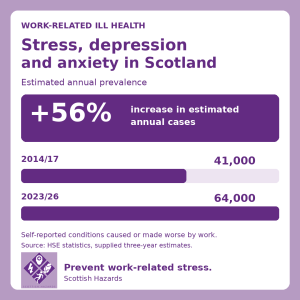 the estimated annual number of workers in Scotland experiencing work-related stress, depression or anxiety has increased from 41,000 to 64,000 over approximately a decade – an increase of 56%.
Against this background, Scottish Hazards wanted to establish what regulatory action the HSE has taken to ensure employers comply with their legal responsibilities to protect workers from psychological harm.
The response we received raises serious questions about regulatory accountability, transparency and the HSE’s ability to monitor the effectiveness of its own occupational health interventions.
Three straightforward questions
On 12 August 2026, Scottish Hazards submitted a request under the Freedom of Information Act 2000 seeking answers to three questions:
- How many enforcement notices has the HSE issued for failures to manage work-related stress since introducing its Stress Management Standards?
- How many employers have been prosecuted by the HSE or, in Scotland, the Crown Office and Procurator Fiscal Service for such failures?
- How many proactive inspections targeting work-related stress has the HSE undertaken in each of the last five years?
These are reasonable questions to ask a regulator responsible for protecting the health, safety and welfare of Britain’s workforce.
The HSE introduced its Stress Management Standards in 2004, providing employers with a framework for identifying and managing six key areas of work design associated with occupational stress: demands, control, support, relationships, role and change.
More than two decades later, it is reasonable to expect the regulator to be able to demonstrate the extent to which it has intervened to ensure employers manage these risks.
A disappointing response
It took until 5 November 2026, some 85 calendar days after receiving our request, for the HSE to respond.
The Freedom of Information Act ordinarily requires public authorities to respond within 20 working days. No explanation was provided for the considerable delay.
However, the content of the response is considerably more concerning than the time taken to provide it.
The HSE stated: HSE does not hold the above information in the required format.
It explained that its operational information system, known as COIN, does not enable the easy identification of records relating to work-related stress.
Among the reasons provided were the absence of legislation specifically relating to work-related stress, insufficient categorisation of investigations and concerns, and the fact that work-related stress is not identified as a separate rating topic on inspection records.
These explanations raise fundamental questions about how Britain’s health and safety regulator monitors its activities in relation to one of the country’s most prevalent occupational health hazards.
Difficult to retrieve does not mean information is not held
There is an important distinction between information not being held and information being held in a format that makes it difficult to retrieve.
The HSE acknowledges that relevant information could potentially be identified by searching text fields within its operational information system.
It argues that such searches could produce incomplete or inconsistent results, generate false positives and require significant manual intervention.
Scottish Hazards recognises that searching historical records can present practical difficulties. However, difficulties retrieving information do not, in themselves, provide a statutory justification for refusing disclosure.
The Freedom of Information Act makes provision for public authorities to refuse requests where the cost of compliance exceeds a prescribed limit.
The HSE did not explicitly rely on this provision, provide a cost estimate or explain whether preliminary searches had been undertaken.
Nor did it offer advice on how Scottish Hazards might refine its request to obtain meaningful information within the statutory cost limit.
Public authorities have a duty to provide reasonable advice and assistance to those requesting information. Simply explaining why information is difficult to retrieve falls short of the transparency we would expect from a national regulator.
Work-related stress is a health and safety issue

The HSE’s reference to the absence of specific legislation relating to work-related stress is particularly disappointing.
Whilst there is no standalone Work-related Stress Regulation, employers have clear responsibilities under existing health and safety legislation to protect workers from risks to their health.
Section 2 of the Health and Safety at Work etc. Act 1974 requires employers, so far as is reasonably practicable, to ensure the health, safety and welfare of their employees.
The Management of Health and Safety at Work Regulations 1999 require employers to undertake suitable and sufficient risk assessments and establish appropriate arrangements for managing health and safety.
These duties extend to psychological as well as physical health.
The absence of dedicated legislation should not prevent the HSE from identifying enforcement action associated with particular occupational health hazards.
A modern regulatory information system should be capable of recording not only the legislation under which enforcement action was taken, but also the nature of the hazard that gave rise to that action.
The problem identified by the HSE appears to be one of information management rather than an absence of legal duties.
How does the HSE measure its own performance?
Perhaps the most concerning admission is that work-related stress is not identified as a separate rating topic on HSE inspection records.
How, then, does the HSE establish whether its regulatory interventions are sufficient, appropriately targeted and effective?
How does it identify sectors where employers consistently fail to manage psychosocial risks? How does it determine whether additional inspector resources are required? How does the HSE Board scrutinise performance in relation to work-related stress?
Without reliable information on inspection and enforcement activity, it becomes difficult for workers, trade unions, parliamentarians and occupational health organisations to assess whether the regulator is adequately fulfilling its responsibilities.
It also raises questions about the evidence available to the HSE itself when evaluating its occupational health strategies.
The HSE may hold relevant information through other internal reporting arrangements, but its response provides no indication that these were examined.
The inability to readily retrieve information from one operational database should not be the end of the matter.
Losing the evidence of regulatory activity
The HSE also advised Scottish Hazards that the majority of investigation, inspection and concern records are deleted after seven years.
There are legitimate reasons for organisations to operate records retention policies. However, the routine deletion of records raises important questions about preserving evidence of regulatory performance.
Are anonymised or aggregated statistics retained before records are deleted? Can the HSE evaluate the long-term effectiveness of its Stress Management Standards? What information remains available to demonstrate the impact of previous occupational health initiatives?
Furthermore, our request for proactive inspection figures covered only the last five years. The seven-year retention policy does not adequately explain why this information could not be provided.
Effective regulation requires institutional knowledge and the ability to learn from previous interventions.
Awareness raising is not a substitute for enforcement
Scottish Hazards welcomes initiatives that raise awareness of work-related stress, including the HSE’s Working Minds campaign and its Stress Management Standards.
However, guidance and awareness raising must be supported by credible regulatory intervention.
Employers who fail to assess and control excessive workloads, unreasonable demands, bullying, poor management practices and other psychosocial hazards must understand that these failures can have regulatory consequences.
Too often, responses to work-related mental ill health focus on improving individual resilience rather than addressing the working conditions that contribute to psychological harm.
Employee assistance programmes, counselling, wellbeing initiatives and mental health first aid may provide valuable support, but they cannot replace employers’ legal responsibilities to prevent harm at source.
Trade union health and safety representatives also have a vital role in identifying workplace hazards, representing workers’ concerns and ensuring employers undertake meaningful risk assessments.
A credible enforcement regime should reinforce these preventative measures.
Scottish Hazards is calling for greater accountability
The HSE’s response does not establish that enforcement action has never taken place. It does, however, demonstrate that the regulator cannot readily provide the information Scottish Hazards requested.
That distinction is important, but it should not diminish the seriousness of the issues raised.
Scottish Hazards believes the HSE should:
- Record work-related stress as a distinct occupational health hazard within its operational information systems.
- Publish annual statistics on proactive inspections, investigations, enforcement notices and prosecutions relating to work-related stress.
- Retain aggregated historical information to support long-term evaluation of regulatory interventions.
- Establish clear and measurable objectives for regulatory activity addressing psychosocial hazards.
- Ensure the HSE Board receives sufficient information to scrutinise performance.
- Improve transparency and compliance with its Freedom of Information obligations.
Workers and their representatives are entitled to know what action is being taken to protect their health.
Workers deserve more than guidance
More than 20 years after the introduction of the Stress Management Standards, work-related stress, depression and anxiety remain major causes of occupational ill health.
The increasing prevalence of these conditions demands a regulatory response that is measurable, transparent and effective.
Scottish Hazards believes the HSE must demonstrate that its commitment to preventing work-related stress extends beyond publishing guidance and encouraging employers to act voluntarily.
Employers must be held accountable when they fail to protect workers from foreseeable psychological harm, and the regulator must itself be accountable for the action it takes.
If the HSE cannot readily establish how often it has intervened to address work-related stress, how can workers have confidence that sufficient action is being taken?
Psychological health deserves the same regulatory attention as physical health. Workers should not have to sacrifice either simply to earn a living.
A final message for the HSE, your recording system is broken, as is RIDDOR; please just admit it and fix it.
Source: Health and Safety Executive, Freedom of Information response, reference 202602380, dated 5 November 2026; HSE work-related ill health statistics for Scotland.
Leave a Reply
You must be logged in to post a comment.